
Our craft
Behind every Anteluxe bloom stands a craft that nearly disappeared.
And a handful of artisans who refused to let it.
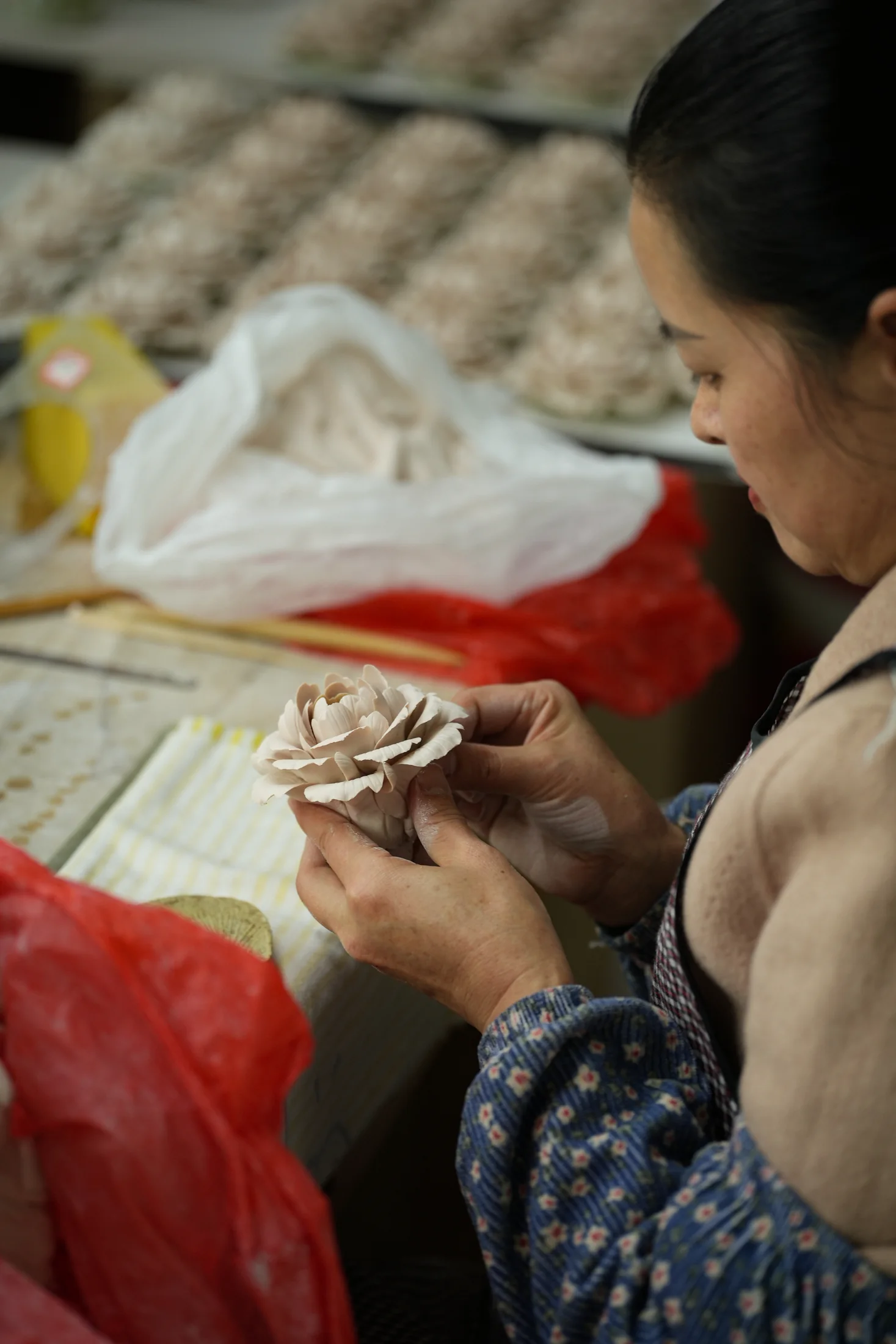
01 / The origin
A flower born in China’s porcelain capital.
In Dehua, a small city in Fujian Province, porcelain has been made for over a thousand years. The world knows it as one of China’s three ancient porcelain capitals. What the world does not always know is that Dehua’s most extraordinary contribution was not a vessel or a vase—it was a flower.
Centuries ago, Dehua artisans discovered that porcelain clay could be pinched and shaped into petals so thin they caught light like the real thing. The technique was called nie su—pinch sculpting—and it became the signature skill of Dehua’s ceramic tradition.
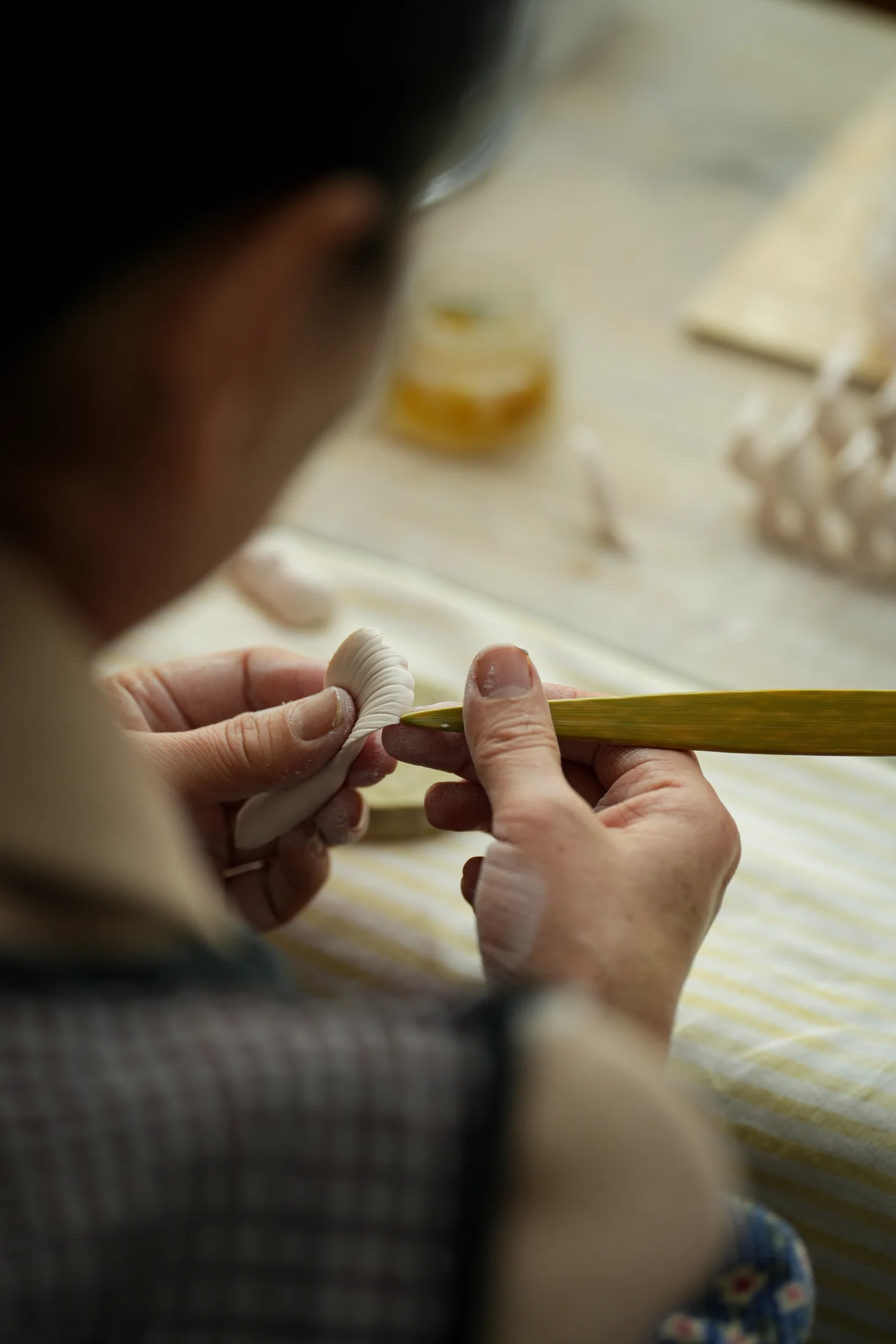
02 / The making of a bloom
Fifty steps. Two firings. One bloom.
A single Anteluxe porcelain flower passes through more than fifty steps before it reaches you. Here is the journey, simplified.
- 01Clay selectionDehua white porcelain clay is selected for purity, plasticity and luminosity.
- 02Pinch sculptingEvery petal is pinched, rolled and curved by hand—without molds or presses.
- 03AssemblyPetals are joined one by one while the clay is moist enough to bond and firm enough to hold.
- 04First dryingThe complete flower dries slowly for days to prevent cracking.
- 05First firingThe dried piece is bisque-fired above 800°C. Not every piece survives.
- 06GlazingWhere required, glaze is applied by hand for the intended finish.
- 07Second firingA second firing, upwards of 1300°C, vitrifies the porcelain and fixes the glaze.
- 08Quality selectionOnly pieces that meet the standard after both firings proceed.
- 09Assembly with baseThe bloom is paired with its aromatherapy stone base and fragrance vessel.
- 10PresentationThe finished piece is checked once more and placed in its gift-ready box.
Why the craft matters
Recognition, risk and a reason to continue.
The peril
In 2006, the Dehua porcelain firing technique entered China’s national list of intangible cultural heritage. Today, fewer than one hundred masters remain who can create a hand-pinched porcelain flower through the full traditional process.
The mission
Anteluxe exists to give this craft a reason to continue. We unite porcelain blooms with fragrance while preserving the small variations that prove a human hand was here.
The name
Ante means before or toward; Luxe means luxury—not excess, but extraordinary care. The Chinese name 予歇 means to give and to rest: a gift that invites you to pause.
03 / The artisans
Among the last practitioners of Dehua’s hand-pinching technique.
The masters who create Anteluxe blooms have spent decades—some, a lifetime—learning to shape porcelain clay into forms so delicate they seem to breathe. This is not a skill that can be rush-taught or scaled. It demands years of apprenticeship, sensitivity to moisture and temperature, and acceptance that many hours of work may end in a cracked kiln.
There are fewer than one hundred of them left. Every Anteluxe piece is, in part, a commitment to ensuring that number does not shrink further.
Materials and presentation
Chosen to honor the work of the hand.
Porcelain clay
Traditional Dehua white porcelain clay, selected for purity and the luminous, translucent quality it achieves at high temperatures.
Scent and stone
A natural porous aromatherapy stone diffuses essential oil steadily, with fragrance composed to complement rather than overpower each bloom.
Presentation
Gift-grade packaging protects the delicate work and makes the unboxing experience part of the piece.
What comes next